
Determinants of central venous pressure
author: Fiona| Engineer of International Sales | UTECH
2024-04-23
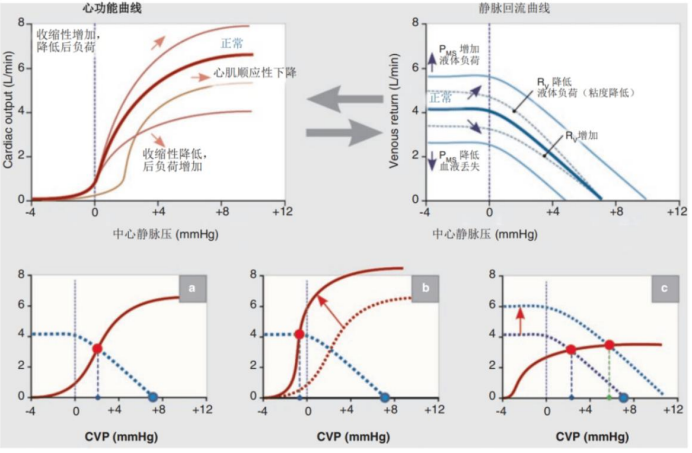
Picture model of the interaction between venous return and cardiac function (contractility).
(a) The intersection of the cardiac function and venous return curves gives cardiac output (CO), venous return, and
Resulting value of CVP.
(b) Maximum venous return with low (negative) CVP in the vertical position ("waterfall" phenomenon) when an increase in contractility does not result in a further increase in CO.
(c) The venous return curve crosses the plateau of the cardiac function curve; therefore, an increase in venous return does not lead to a further increase in CO. Note that based on simultaneous positional shifts in the curve, the resulting CVP values can increase and decrease depending on the individualized response to similar interventions (i.e., fluid loading, vasopressors). CVP central venous pressure, CO cardiac output, PMS mean circulating filling pressure, RV venous return resistance
(a) The intersection of the cardiac function and venous return curves gives cardiac output (CO), venous return, and
Resulting value of CVP.
(b) Maximum venous return with low (negative) CVP in the vertical position ("waterfall" phenomenon) when an increase in contractility does not result in a further increase in CO.
(c) The venous return curve crosses the plateau of the cardiac function curve; therefore, an increase in venous return does not lead to a further increase in CO. Note that based on simultaneous positional shifts in the curve, the resulting CVP values can increase and decrease depending on the individualized response to similar interventions (i.e., fluid loading, vasopressors). CVP central venous pressure, CO cardiac output, PMS mean circulating filling pressure, RV venous return resistance
Central venous pressure depends largely on the tone (and resulting compliance) of the venous reservoir. It is believed that CVP is determined by blood volume
and venous bed capacity, the condition of the cardinal veins and heart valves (to a greater extent the tricuspid valve), and the compliance of right ventricular and pulmonary artery pressures.
determined by the correspondence between them. These numerous factors severely hinder direct clinical interpretation of baseline values and changes in CVP.
and venous bed capacity, the condition of the cardinal veins and heart valves (to a greater extent the tricuspid valve), and the compliance of right ventricular and pulmonary artery pressures.
determined by the correspondence between them. These numerous factors severely hinder direct clinical interpretation of baseline values and changes in CVP.
According to the Guyton circulation model, there are three main determinants of cardiac output—the pumping function of the heart, peripheral blood flow resistance, and the capacity of the circulatory system. Since venous return is equivalent to cardiac output, an increase in the latter can occur by increasing mean systemic pressure and decreasing the response to venous return or CVP
resistance to achieve. This is supported by the observation that cardiac output increases and CVP simultaneously decreases during moderate physical activity.
resistance to achieve. This is supported by the observation that cardiac output increases and CVP simultaneously decreases during moderate physical activity.
If you want to learn more details about our products, please check this link below: Patient Monitor, UTECH, China,patient monitor (chinautech.com)
Medical Cannabis for Chronic Pain Tied to Arrhythmia Risk
Hemodynamics--Central Venous Pressure (CVP) and Pulmonary Artery Wedge Pressure (PAWP)
Related Article

Discover how summer heat affects the body and learn the difference between being overheated and having a fever. This guide provides practical tips on how to correctly measure body temperature in hot weather and highlights the features of UTECH Medical’s UTM10 infrared thermometer, including its one-second, non-contact measurement, 30-reading memory, and reliable accuracy for home and public safety.
Too Hot? Check Your Temperature the Right Way This Summer

Learn key facts about Marburg virus disease (MVD), a rare but severe hemorrhagic fever caused by a Filoviridae RNA virus. Discover how the virus spreads from Egyptian rousette bats to humans, its initial symptoms—including high fever, bleeding, and organ failure—and current laboratory diagnosis methods like RT-PCR. Explore supportive care treatments, prevention strategies
Marburg virus disease

Can asthma go away? Learn about asthma remission, genetic factors, symptoms, asthma cough, and the warning signs of life-threatening status asthmaticus.
Can Asthma Go Away Completely?

Explore tHIS ASEAN 2026, Southeast Asia’s leading healthcare exhibition connecting global medical technology providers with regional distributors, hospitals, and healthcare professionals. Discover ASEAN healthcare market growth, medical device opportunities, patient monitoring systems, pulse oximeters, AI healthcare, remote patient monitoring, and emerging trends shaping the future of healthcare across Southeast Asia.
tHIS ASEAN 2026: Southeast Asia Healthcare Exhibition and Medical Device Opportunities