
Evolved role of the cardiovascular intensive care unit (CICU)
author: Myra
2023-12-22
 1.Background
Cardiovascular intensive care refers to special systemic management for the patients with severe cardiovascular disease (CVD), which consists of heart disease and vascular disease. The heart diseases include coronary artery diseases (CAD) such as angina and myocardial infarction, cardiomyopathy, myocarditis, heart arrhythmia, hypertensive heart disease, and valvular heart disease. The vascular diseases include aortic dissection, aortic aneurysm, peripheral artery disease, etc.
It is reported that CVD is the second leading cause of mortality worldwide, accounting for 17 million deaths in 2013. Although the risk factors for the development of CVD are similar throughout the world, improvement of cardiovascular risk factors such as smoking and obesity is effective to reduce the incidence of CVD.
In recent years, in order to prevent death due to CVDs, an intensive care unit for severe CVD patients, so-called cardiovascular intensive care unit (CICU), has been developed in many general hospitals.
2.Epidemiology of cardiovascular diseases
CVDs consist of various heart diseases and vascular diseases. The pathogenesis of onset depends on each CVD. There are many risk factors for heart diseases: age, smoking, obesity, hypertension, diabetes mellitus, and hyperlipidemia. These risk factors increased from 12.3 million deaths (25.8%) in 1990 to 17.9 million deaths (32.1%) in 2015. Many important cardiovascular risk factors are modifiable by lifestyle change and drug treatment such as prevention of hypertension, hyperlipidemia, and diabetes. It is estimated that 90% of CVD is preventable.
CVDs are common among elderly people. In the USA, it is reported that 11% of people between 20 and 40 years old have CVD, while 37% between 40 and 60 years, 71% between 60 and 80 years, and 85% over 80 years have CVD.
According to vital statistics of the Ministry of Health, Labor and Welfare in Japan, CVD is the second leading cause of death in Japan. About 200,000 people died due to CVDs in 2015. In addition, approximately 60,000 Japanese people have an out-of-hospital cardiac arrest due to CVDs every year and the overall life-saving rate is still low.
Since the CVDs contain many fatal emergency diseases, coronary care unit (CCU) was established as a facility responsible for intensive care in the acute phase in order to improve the outcome of the CVDs.
3.Progress from the coronary care unit to the cardiovascular intensive care unit
The development of CCU in the mid-twentieth century was a major advance in cardiology practice. CCU was developed in the 1960s when it became clear that close monitoring by specially trained staff, cardiopulmonary resuscitation (CPR), and medical interventions can reduce mortality due to CVD complications such as cardiogenic shock and fatal arrhythmias.
CCU, which was initially established as a separate unit for the early detection and treatment of arrhythmias complicating AMI, currently provides the setting for the monitoring and treatment of a wide variety of critical CVD states. Therefore, the CCU has come to be called the CICU. The role of cardiovascular intensive care has evolved with the rapid progress of diagnostic and therapeutic strategies in the practice of clinical cardiology. The technological developments of clinical cardiology, such as invasive hemodynamic monitoring and intracoronary interventional procedures and devices, have resulted in evolution of intensive care for CVDs. Subsequently, severe CVD patients admitted to CICU are increasing year by year.
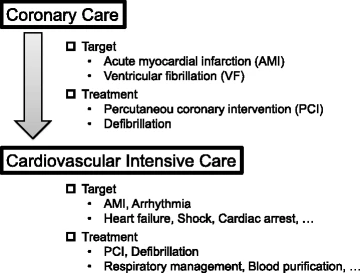
In the era of CCU, the main target patients were acute myocardial infarction (AMI). Percutaneous coronary intervention (PCI) and defibrillation were important treatments. Subsequently, as the target patients spread to heart failure, shock, out-of-hospital cardiac arrest, etc., the need for cardiovascular intensive care including respiratory management and blood purification therapy increased.
 4.Features of cardiovascular intensive care
The CICU is a hospital ward specialized in the care of patients with severe heart diseases, such as AMI, cardiomyopathy, and arrhythmias. Those patients often complain of heart failure and cardiogenic shock. Therefore, the severe CVD patients need continuous monitoring and intensive care.
The main feature of CICU is the availability of the continuous monitoring of the cardiac rhythm by electrocardiography (ECG). This allows early intervention with medication, cardioversion, or defibrillation, improving the prognosis of the severe CVD patients. Furthermore, cardiovascular intensive care needs to have various kinds of diagnostic medical equipment as shown in Table 1.
Table 1 Diagnostic equipment necessary for cardiovascular intensive care
 Also, therapeutic equipment necessary for cardiovascular intensive care is shown in Table 2.
Table 2 Therapeutic equipment necessary for cardiovascular intensive care
 In addition to circulation management, systemic management is required in the CICU. So, it is necessary to prepare a ventilator and a blood purification device as well as the auxiliary circulation devices, such as intra-aortic balloon pump (IABP) and percutaneous cardiopulmonary support system (PCPS) in the CICU. Recently, it is also indispensable to provide the equipment for performing targeted temperature management for the patients resuscitated from cardiogenic out-of-hospital cardiac arrest (OHCA).
5.Conclusions
Cardiovascular intensive care unit (CICU) is a hospital ward that specializes in the care of patients who have experienced ischemic heart disease as well as other severe heart disease. Furthermore, the patients in the CICU often have various complications such as respiratory failure and renal failure. Therefore, medical staffs who work at CICU are required to have the ability to practice systemic intensive care.
6.Authors and Affiliations
Department of Emergency and General Medicine, Kumamoto University Hospital, 1-1-1 Honjo, Chuo-ku, Kumamoto, 860-8556, Japan,Shunji Kasaoka
If you would like to learn more about our products, please visit our website——www.chinautech.com.
|
Walking Fast May Help Prevent Type 2 Diabetes
The Introduction of Ventilatory Failure
Related Article

Discover how summer heat affects the body and learn the difference between being overheated and having a fever. This guide provides practical tips on how to correctly measure body temperature in hot weather and highlights the features of UTECH Medical’s UTM10 infrared thermometer, including its one-second, non-contact measurement, 30-reading memory, and reliable accuracy for home and public safety.
Too Hot? Check Your Temperature the Right Way This Summer

Learn key facts about Marburg virus disease (MVD), a rare but severe hemorrhagic fever caused by a Filoviridae RNA virus. Discover how the virus spreads from Egyptian rousette bats to humans, its initial symptoms—including high fever, bleeding, and organ failure—and current laboratory diagnosis methods like RT-PCR. Explore supportive care treatments, prevention strategies
Marburg virus disease

Can asthma go away? Learn about asthma remission, genetic factors, symptoms, asthma cough, and the warning signs of life-threatening status asthmaticus.
Can Asthma Go Away Completely?

Explore tHIS ASEAN 2026, Southeast Asia’s leading healthcare exhibition connecting global medical technology providers with regional distributors, hospitals, and healthcare professionals. Discover ASEAN healthcare market growth, medical device opportunities, patient monitoring systems, pulse oximeters, AI healthcare, remote patient monitoring, and emerging trends shaping the future of healthcare across Southeast Asia.
tHIS ASEAN 2026: Southeast Asia Healthcare Exhibition and Medical Device Opportunities