
Does Nail Polish Affect Pulse Oximeter Accuracy? — The Science Behind the Signal —

Accuracy & Wellness
Does Nail Polish Affect Pulse Oximeter Accuracy?
— The Science Behind the Signal —
In clinical emergency settings, medical professionals frequently encounter a frustrating phenomenon: a patient who appears physically stable but has a pulse oximeter reading that suggests a life-threatening drop in oxygen. Often, after a frantic rush to perform arterial blood gas tests, the culprit is discovered to be a common cosmetic—dark nail polish.
This isn't just an anecdotal observation; it is a documented technical limitation. While we have previously discussed how skin tone affects accuracy, external physical barriers like the "Manicure Barrier" pose an equally significant risk to diagnostic accuracy. Understanding the science behind this interference is crucial for ensuring that a simple fashion choice doesn't lead to a complex medical error.
1. The Physics: Why Your Oximeter Can’t "See" Through Color
To understand why a manicure interferes with your health data, we have to look at how a pulse oximeter functions. The device sends two beams of light—Red (660nm) and Infrared (940nm)—through your fingernail and into the vascular bed of your fingertip.
As highlighted in a classic study published in PubMed (3382042), certain pigments act as an optical filter. Because darker nail polishes absorb significant amounts of light at the 660nm wavelength, the sensor confuses the pigment with deoxygenated hemoglobin. This leads the device to believe your blood is less saturated with oxygen than it actually is.
2. The "Danger Zone": Ranking the Most Disruptive Colors
Not all nail polishes are created equal in the eyes of a sensor. Clinical research has identified a specific hierarchy of interference:
- Black, Blue, and Green: These are the high-risk colors.
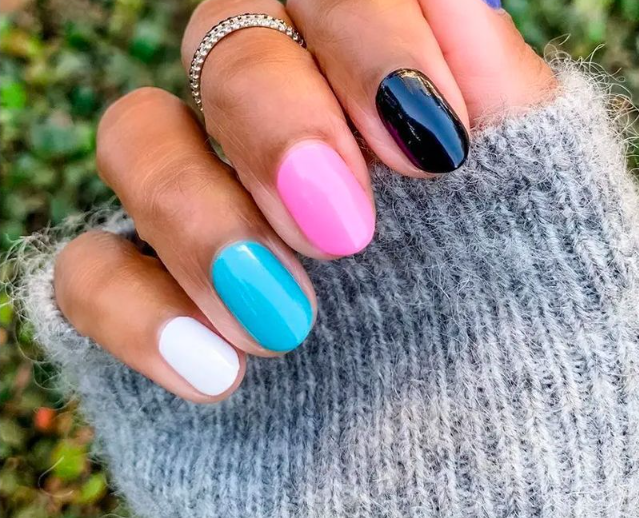 Research indicates that black nail polish can cause an average decrease of 3% to 6% in SpO₂ readings.
 - Purple and Brown: These provide moderate interference, often causing erratic readings that fluctuate unexpectedly.
- Red and Pink: Interestingly, red polish often shows the least interference because it reflects red light rather than absorbing it, though it can still cause a slight "shimmer" in the data accuracy.
3. The Modern Challenge: Gel, Acrylics, and "Shellac"
In the past, a quick swipe of acetone could solve the problem. However, modern manicures like Gel-based polishes and Acrylics present a new challenge.
A study from the Singapore Medical Journal (SMJ) found that even translucent or light-colored gel manicures resulted in a statistically significant drop in readings, typically between 1.1% and 1.9%. While this might seem negligible for a healthy individual, for a patient monitoring chronic respiratory issues, a 2% error can be the difference between a routine day and a medical emergency.
Furthermore, as noted in recent reviews on PMC (10468177), it isn't just the color—it's the thickness. The layers of base coat, color, gel, and topcoat create a physical barrier that scatters light, making it difficult for the sensor to find a consistent "pulse signal."
4. The "Workaround": What to Do If You Can’t Remove the Polish
If you are in a situation where you need an accurate reading but cannot immediately remove your manicure, medical science offers a clever solution.
A study published in PubMed (17098347) tested the efficacy of "Side-to-Side" positioning. Instead of clipping the oximeter vertically over the nail, you can rotate the sensor 90 degrees and clip it across the sides of the finger (from the left side of the finger to the right).
By bypassing the "Manicure Barrier" entirely and sending light through the skin on the sides of the fingertip, researchers found that the SpO₂ readings were significantly more accurate and aligned closely with the clinical "Gold Standard" of oxygen monitoring.
5. Pro-Tips for Accurate Home Monitoring
- The "Designated Finger" Rule: If you are a regular at the nail salon, consider leaving one finger (typically the index or middle finger) free of dark polish or heavy gems to serve as your "health monitoring finger."
- Check the Waveform: If your device has a Plethysmogram (Pleth) display, look at the wave. If the wave looks jagged or weak while you are wearing nail polish, do not trust the numerical SpO₂ reading.
- Warmth is Key: Cold fingers constrict blood flow (poor perfusion), which compounds the interference caused by nail polish. Always rub your hands together to increase circulation before taking a measurement.
Precision When It Matters Most
In the world of medical monitoring, clarity is everything. While many factors can cloud your data—from skin pigment variations to dark manicures—having a device that can help you identify these interferences is vital.
Our Fingertip Pulse Oximeter - IO2 is equipped with a high-definition OLED screen that displays not just your oxygen levels, but also your real-time pulse intensity and waveform. This allows you to visually confirm if the device has a "clear view" of your blood flow. With its ultra-low power consumption and built-in memory for 120 hours of data tracking, it provides the reliable, long-term health insights you need to navigate the complexities of daily wellness—manicure and all.
| Display Screen | High-definition OLED display |
| Real-Time Monitoring | Displays SpO₂, pulse intensity, and waveform |
| Data Storage | Built-in memory for 120 hours of tracking |
| Efficiency | Ultra-low power consumption |
Note: This device is a tool for daily health management and wellness monitoring. It is not intended to replace professional medical diagnosis or the "Gold Standard" arterial blood gas test.
 Too Hot? Check Your Temperature the Right Way This Summer
  Marburg virus disease
  Can Asthma Go Away Completely?
  tHIS ASEAN 2026: Southeast Asia Healthcare Exhibition and Medical Device Opportunities
 Is My Blood Oxygen Level Normal?
 Ebola Outbreaks in Africa: Clinical Challenges, Supportive Care, and the Role of Patient Monitoring
  Why Is AI Making Medical Devices More Expensive? A Patient Monitor Case Study
  COPD Statistics 2026: Global Prevalence, Mortality, Risk Factors and Healthcare Costs
  Nocturnal Hypoxia and Cardiac Instability in Elderly Patients: The Clinical Value of Continuous Monitoring
  Watching the World Cup at Estadio Azteca? Why Your SpO2 Isn't Accurate?
  Breaking 2: What the 2026 London Marathon Record Tells Us About SpO2 and Your Training
  Normal Blood Oxygen Saturation Levels in Elderly vs Young Adults: What’s the Difference?
  More Than SpO₂ — What the Perfusion Index Truly Reveals
  Does Skin Tone Affect Pulse Oximeter Accuracy? -The Science Behind the Signal
  Rethinking Central Venous Pressure ( CVP) : From Traditional Marker to Part of Comprehensive Hemodynamic Assessment
  Understanding COPD and Why Oxygen Monitoring Matters More Than Ever
  Why Everyone Should Have a Pulse Oximeter
  Best Handheld Pulse Oximeters for Clinical Use in 2026
  How to Choose the Best Portable Pulse Oximeter for Home Use
  How to Choose the Right Infant Pulse Oximeter for 2026